
Why Do Eyebrows Turn Red After Permanent Makeup?
This is one of the most common questions I hear from clients who come to me with old permanent makeup. Why do eyebrows turn red after permanent makeup? And honestly, I completely understand why it is frustrating. You chose a brown or natural-looking eyebrow colour, so why are you now looking in the mirror years later and seeing red, orange or pink looking eyebrows? The answer often comes down to two things: what the ink formula contains and how the pigment was implanted into the skin.
What colour you will use on my eyebrows?
When we look at a brown PMU pigment, we might think we are simply looking at “brown ink”. But a brown colour is usually created by combining different colourants. In simple terms, you can think of the formula as a balance of red, yellow and black. And this is where things get really interesting. The black component can come from different types of pigment, including carbon black (CI 77266) or black iron oxide (CI 77499). These colourants have different characteristics, and the way they behave in a formulation and in the skin can influence the healed and aged result. But pigment is only one part of the story.
Every undesired outcome can be avoided, if artist understand how that pigment should be implanted, how much should be implanted, which needle and machine settings to use, what skin type they are working on and, most importantly, what the brows are likely to look like after they heal and age. If you have mature skin and are considering microblading, I’ve also written about whether microblading is safe for mature skin and what should be considered before treatment. Read about it here.
What is actually inside your eyebrow pigment? This can influence how your eyebrows will heal.
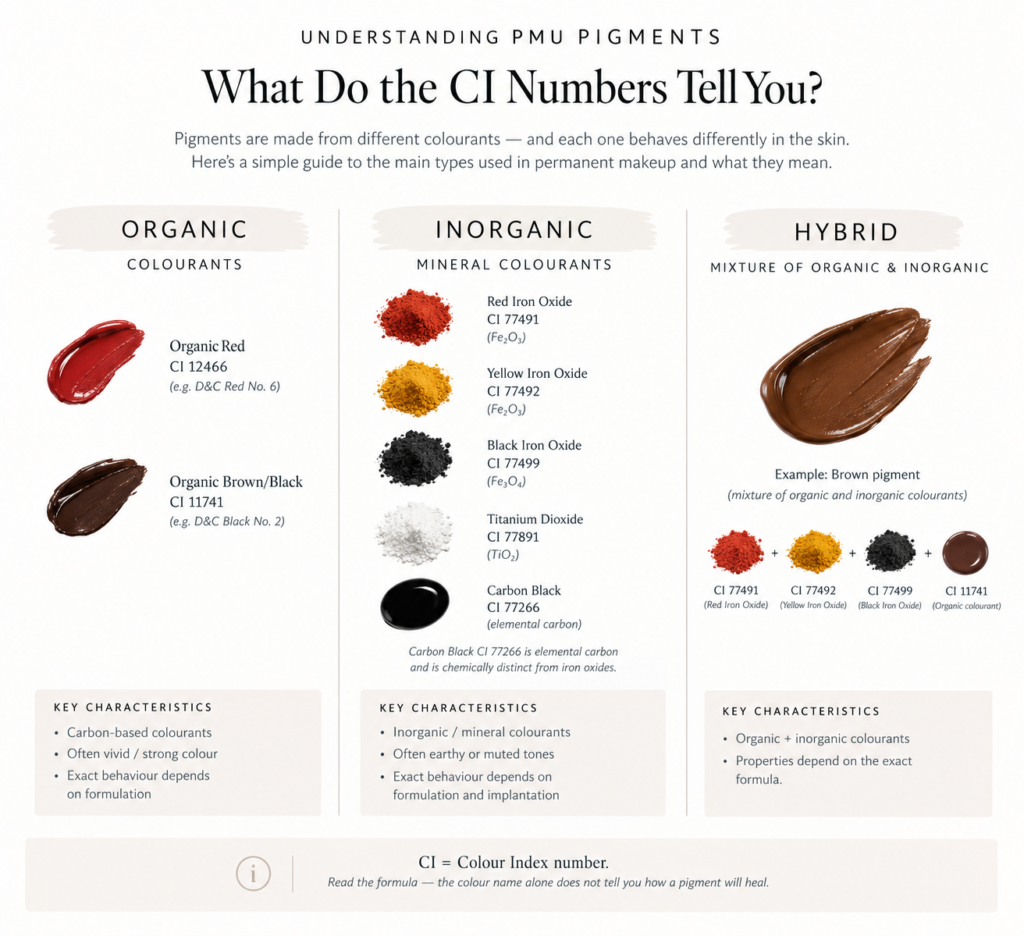
Before we talk about red eyebrows, we need to talk about what creates the colour in the first place. Permanent makeup pigments contain colourants identified by CI numbers, or Colour Index numbers. These numbers help an artist understand which colourants are present in a pigment formula.
For example:
- CI 77491 – Red Iron Oxide
- CI 77492 – Yellow Iron Oxide
- CI 77499 – Black Iron Oxide
- CI 77266 – Carbon Black
- CI 77891 – Titanium Dioxide
A single brown PMU pigment can contain several of these colourants, sometimes alongside other organic colourants. This is why I always tell PMU artists that knowing the name of a pigment is not enough. You need to know what is actually inside the bottle. And even that is only the beginning. You then need to understand how that particular formula behaves when you put it into different skin.
Organic, inorganic and hybrid pigments; why the terminology can be confusing and how it affect permanent makeup healed results?
You may have heard PMU artists talking about organic, inorganic and hybrid pigments. But there is something important to understand here: the terminology used in the PMU industry does not always perfectly match the formal pigment classification system.
For example, Carbon Black, CI 77266, is often described in PMU as an “organic” pigment because of the way it behaves and because it is based on carbon. However, in the Colour Index system, CI 77266 sits within the inorganic section. Carbon black is essentially elemental carbon, and although it can behave more like many organic pigments in terms of its colouring characteristics, its formal Colour Index classification is inorganic.
This is exactly why I don’t like making pigment decisions based simply on the words organic or inorganic written on a pigment description.
Inorganic colourants
Inorganic colourants commonly used in PMU include mineral pigments such as iron oxides. Some of the important CI numbers you may come across are:
- CI 77491 — Red Iron Oxide
- CI 77492 — Yellow Iron Oxide
- CI 77499 — Black Iron Oxide
- CI 77891 — Titanium Dioxide
And then there is:
- CI 77266 — Carbon Black
Carbon black is chemically different from iron oxides, even though the Colour Index places it in the inorganic section. It is essentially elemental carbon and has exceptionally strong colouring power.
Organic colourants
Organic pigments are a different group of synthetic based colourants. They can provide strong, vivid colours and high colouring strength.
But this is where I want to make something very clear: “organic” does not automatically mean better, stronger, longer-lasting or more difficult to remove. And “inorganic” does not automatically mean softer, safer or more natural.
The behaviour of a PMU pigment depends on the actual colourants in the formula, their proportions, particle characteristics, the complete formulation and, of course, what happens when the artist implants that formula into the skin.
Hybrid ink
Hybrid pigments combine organic and inorganic colourants in the same formula. And this is where things become particularly interesting for permanent makeup. Two pigments can both be called “hybrid”, yet behave quite differently because their individual colourants and proportions can be different. So when I work with a pigment, I don’t want to know only whether the manufacturer calls it organic, inorganic or hybrid.
I want to know what is actually inside the bottle. Because ultimately, it is the formula, the client’s skin and the way the artist works with that formula that influence the healed result.
Carbon Black vs Black Irone Oxide affecting healed eyebrows permanent makeup.
Now let’s get to the part that matters when we talk about colour changes in eyebrows. Two black colourants you may find in PMU pigments are: Carbon Black – CI 77266 and Black Iron Oxide – CI 77499
They are not the same thing. Carbon black is a very strong black colourant. Because of its strong colouring power and characteristics, even a relatively small amount can have a significant influence on the overall colour of a formula. This pigment is also metabolised differently by your body and lasts longer than any other colourant. Research showing that pigment concentration decreases in skin over time, you can read here more about it. This is one reason why an artist needs to understand what they are working with. If a pigment containing carbon black is implanted too deeply or too heavily, the problem isn’t necessarily that the pigment is “bad”.
The problem can be how the artist has used it. Too much saturation, excessive depth, unsuitable needle selection, incorrect machine settings, too much pressure or choosing a formula that isn’t appropriate for that particular skin can all influence the healed result. Instead of beautiful, soft brows, you can end up with brows that look too dense, too dark, greyish or blueish.
This is why I always say that an artist needs to be able to read the pigment before putting it into the skin and know how to safely work with it.
So why do permanent makeup eyebrows turn red?
Now we can come back to the original question. Why do eyebrows turn red after permanent makeup? One reason is the way the different colourants in the original formula behave and remain visible over time. Imagine a brown pigment made from a combination of warm and dark colourants. Immediately after treatment, all of those colours contribute to the brown you see. But the skin does not necessarily retain or display every component of the formula in exactly the same way forever. As the pigment ages and the different components become less visually dominant at different rates, the balance of colour can change. For more information about what happens to pigment particles after they are introduced into the skin, see this scientific article.
If the darker component becomes less dominant while the warmer red or yellow components remain more visible, the brows can gradually appear warmer, orange, or red.
This can happen because iron oxide black may be metabolised and broken down by the body differently/quicker from carbon black. As the darker components become less visible, the warmer colourants, such as red and yellow, can become more apparent. This is why brows may gradually appear warmer, yellow, orange, or reddish over time. I’ve also written more about how permanent makeup fades over time and why the colour can change as the pigment gradually fades.
Carbon black is often added to pigment formulations to help create a deeper, cooler colour and improve the overall colour balance of the formula. This is why saying simply: “Iron oxide turns red.” is an oversimplification. The reality is more complicated. The exact result depends on the pigment formula, the individual colourants, their concentration, implantation, the client’s skin and how the pigment ages in that particular person. And this is exactly why two people can have what looks like a similar brown pigment initially and completely different healed brows years later.
Is carbon black there to stop eyebrows turning red?
Carbon black can play an important role in the colour balance of a pigment because of its strong black colouring power. It can help maintain the darker component of a formula and influence how the colour appears as the pigment ages. But I would never tell you that carbon black is a magic ingredient that guarantees your brows will never turn red. It doesn’t work like that. The formula matters, but so does the way the artist implants it. A strong pigment implanted too deeply is still going to create a problem. This is particularly important when working on skin that is mature, thin, delicate, oily or otherwise challenging. The same pigment does not automatically produce the same result on every client.
The pigment in the bottle is not the healed result, important to know, so your eyebrows will not turn red.
This is something I wish every client knew before booking permanent makeup. What you see in the bottle is not necessarily what you will see in your skin years later. And what you see immediately after treatment isn’t your final result either. The artist needs to think several steps ahead.
I am not just asking:
“Does this colour look nice today?”
I am asking:
“What is this formula made from?”
“How will these colourants behave in this skin?”
“Which skin depth should I implant it?”
“Is my saturation enough for the skin?”
“What will this look like once it heals?”
And, importantly: “What is this likely to look like as this client gets older?”
This is something I have always considered in my work. Since I started working as a full-time permanent makeup artist, I have wanted my clients to have soft, naturally defined brows that gradually fade over time, rather than brows that become increasingly obvious or difficult to correct as the years go by.
That last question matters enormously.
Sometimes the problem isn’t the pigment
Pigment doesn’t exist in isolation. It sits inside someone’s skin. And every person’s skin is different. A pigment that behaves beautifully in one client may not produce the same result in another. For example, I approach mature skin differently from young, firm skin. Mature skin can be thinner and more delicate, and it may respond differently to trauma and pigment implantation. Oily skin can also behave differently from dry skin when it comes to retention and healed definition. That is why I don’t believe in a universal recipe such as:
“This pigment is for blondes.”
or
“This pigment is for oily skin.”
or
“This pigment always heals neutral.”
There are simply too many variables. A good PMU artist needs to look at the person, the skin, the existing hair, the undertone, previous PMU, the pigment formula and the desired healed result before deciding how to work. And sometimes the problem isn’t the pigment at all.
Can old PMU simply be covered with a new colour?
This is another important point, especially when I assess old microblading. Sometimes clients tell me, “My microblading turned red.” However, when I examine the brows, I can often see that more may be happening than just a change in pigment colour.
If the previous artist implanted the pigment too deeply, the treatment may have caused unnecessary trauma to the skin, potentially contributing to scar tissue or changes in skin texture. In these cases, both residual pigment and changes in the tissue itself may influence how the brows look today.
When I don’t know the details of a previous treatment, it can be much more difficult to determine exactly what the previous artist did and what I am seeing in the skin today
Was it actually microblading?
- How deep was it implanted?
- What pigment was used?
- How many times was the area treated?
- Was there previous correction?
- Was the skin overworked?
- Is there scar tissue?
These questions matter.
This is also why I am always cautious when a client comes to me with old PMU and says, “Can you just cover it with a new colour?”
Sometimes the answer is yes.
Sometimes the old pigment is too saturated or was implanted too deeply, which may have compromised the skin. In these situations, I may need to consider correction or removal before applying a new colour.
In my next blog, I’ll explore this topic in much more detail, including when you can safely cover old PMU and when you should consider correction or removal first.